
Handmade Fabric
A quick history of khadi and fabric that represents a place in more ways than one

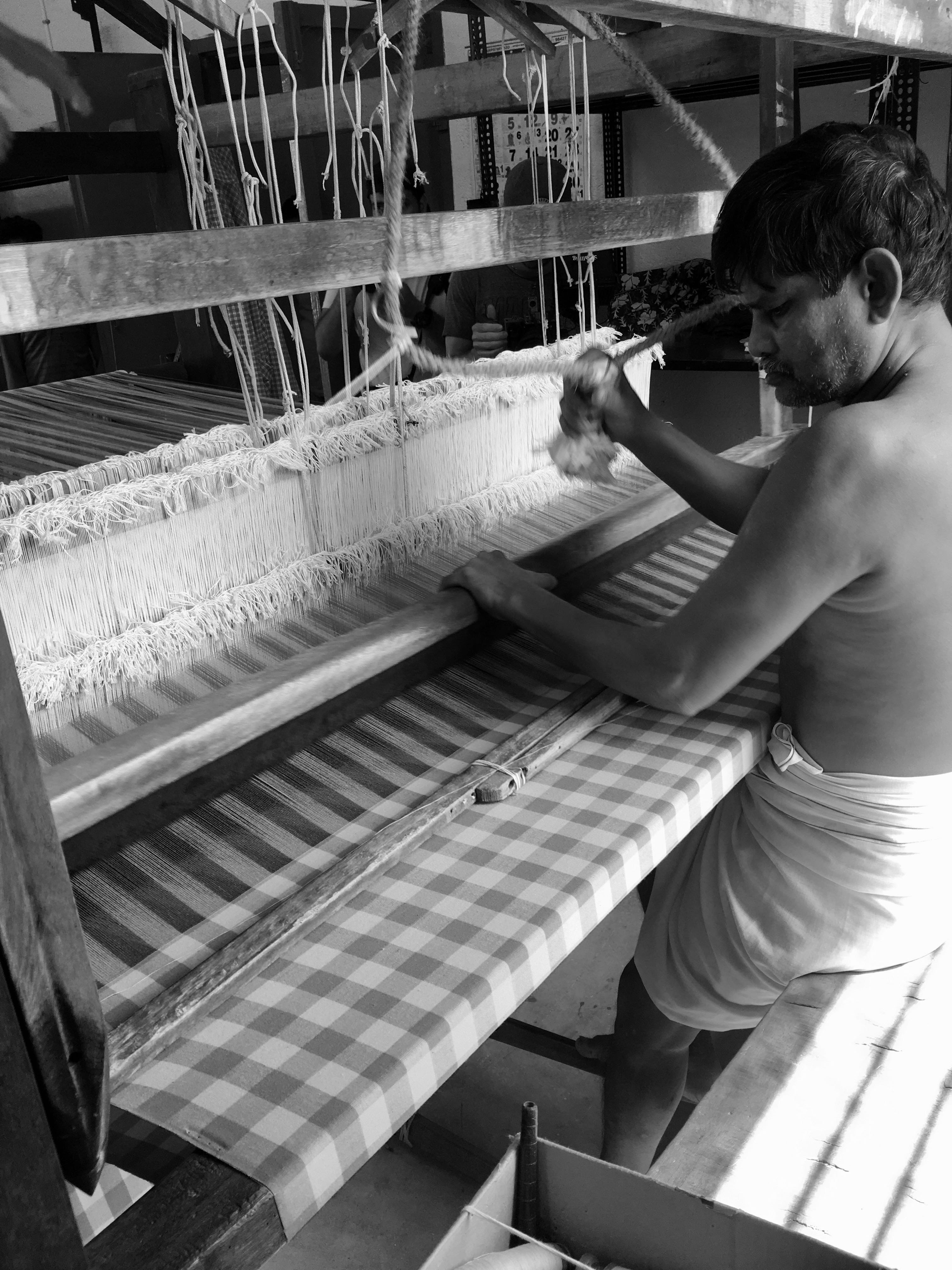
In the winter, Indian farmers harvest their cotton. Most of the cotton goes to the numerous industrial gins and spinners throughout the country. Some of the cotton is exported, and even a smaller amount is used in studios for hand spinning. At the hand spinning studios, artisans pull and twist the raw cotton into yarn using a charkha, a wooden, hand-powered spinning wheel. The hand-spun yarn then goes to hand-loom weavers who sit at large wooden looms and weave the yarn into fabric. The resulting fabric is called khadi.
Khadi has been around since the advent of the handloom. The loom is a wooden frame with a certain yardage of loose yarn rolled on a roller at the back. The yarn is guided into parallel rows by threading it through the eye of small metal guides called heddles. The yarn then goes through another set of parallel metal pieces called a beater, and is rolled onto a front roller. Those pieces of yarn are called the warp. The weaver uses foot pedals to move certain warp yarns up and down and pushes a handheld, boat-shaped piece of wood with a spindle of yarn (the weft) across the loom, and uses the beater to secure the weft taught in the warp. Repeating that process over and over again results in woven fabric.
Handloom weaving in India peaked in the 1600s, when the East India Company secured exclusive rights to trade with India. Before the invention of the power loom, hand-woven cottons and silks from villages all over India were highly sought after in the European market for their fineness and intricacy. By the mid-1700s, the Industrial Revolution in Britain brought the power loom, which flipped the dynamic. India became a great market for the abundance of machine-woven fabric England produced. England would import the fine Indian cotton, spin and weave it with power looms, then turn it around and sell it back to India at a high mark-up.
When Gandhi led India’s campaign for independence from British rule, the British-made cloth, made from India’s cotton and sold back to India, became a symbol of colonization. Khadi, in turn, became a symbol of independence. India could and, in Gandhi’s eyes, should produce all their own clothing. Handspinning and weaving clothing shifted from a means of making textiles to a symbol of self-reliance and resistance to the British economic dominance.
One of Gandhi’s many arguments for rejecting Western clothing was that clothing made by Indians, in India, using indian materials was better suited for the climate. The biggest difference between a hand and machine-loomed fabric is the loft– the amount of air pockets between the warp and weft. Because handloom machines are manpowered, it is impossible to get as high tension and consistency as a powerloom. Instead, the handmade fabric has small air pockets, invisible to the naked eye, that greatly increase the fabric’s breathability and insulation. Along with the long staple cotton native to India that can be spun into super fine yarn, you get an extremely lightweight, breathable fabric. Perfect for the hot and humid climate of India. Khadi fabric holds a sense of place. Not only does it represent the culture of India, but it also represents the seasonal cycles, ecosystems, and climate of the country.
NOTES
https://www.researchgate.net/publication/388546448_REVIVING_KHADI_EXPLORING_SUSTAINABLE_QUALITIES_AND_PROMOTING_KHADI_AMONG_FASHION_DESIGN_STUDENTS
https://www.jsr.org/hs/index.php/path/article/view/3965/1951
Thank you for bringing up Khadi.
It was phased out in my community in India, when I was a child in the 90s India, for the more uniform looking and softer fabrics. Also, the time spent by the worker given the price, could not compete in the free market. Only the hardcore environmentalists in my family refused to give it up and have always worn it. In the last decade, it became a niche product with a basis in nostalgia and the nationalist push from the govt put a spotlight on it again. The upper middle class have added it as yet another collectible as a consumer and the political class wear it to virtue signal. Its an emotionally charged fabric for sure.
I do want something in khadi in my wardrobe. Someday !
I've always wondered what khadi is and why it is special. Thanks for always expanding my horizons!